
Opposition
The role of Opposition has been, and always will be, an integral part to a healthy democracy. The Opposition are important within Parliament because…
- They hold the Government to account on the promises and policies set out in their election manifesto - the commitments on which it was elected
- They develop alternative ideas and policies, which give voters a choice about how the country should be run
My role as a Shadow Secretary of State
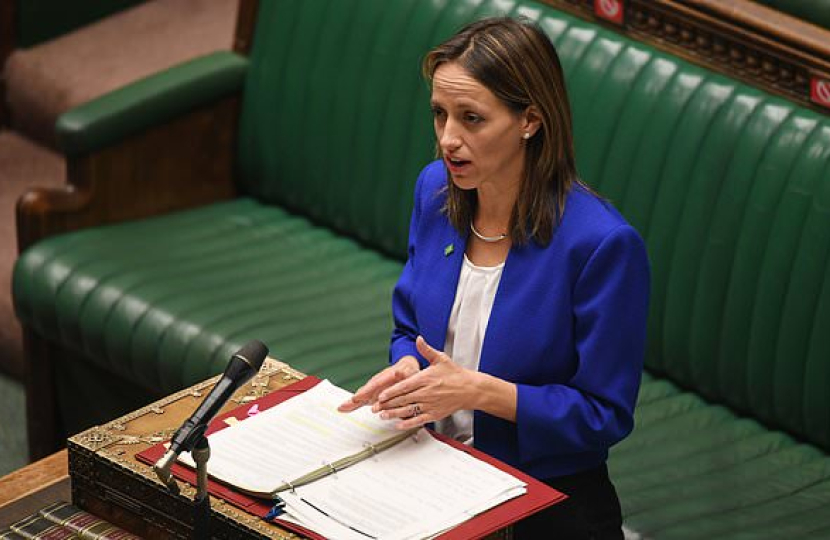
Currently I hold the position of the Shadow Secretary of State for the Department of Work and Pensions (DWP). This means that it’s my job to hold Pat McFadden, the Labour Secretary of State for the Department of Work and Pensions to account. For example, after months of pushing the Secretary of State for Work and Pensions to reverse their decision to cut Winter Fuel Payments, among other pressures, they eventually decided to.
As a member of the Shadow Cabinet, I'm limited in which debates I can speak in as they won't always relate to my subject area of Work and Pensions.
Procedure
Oral or written questions
Every few weeks, each government department answers questions at the Dispatch Box from backbench MPs and Shadow Ministers. There is a limit to the number of questions that can be asked. MPs can also table a written question to the relevant Government department, which are published in Hansard: http://www.parliament.uk/business/publications/hansard/
Adjournment Debates
MPs may be able to raise a constituent's issue in a half-hour Adjournment Debate. To get an adjournment debate, MPs must be successful in a ballot of Members of Parliament or have the subject chosen by the Speaker.
Petitions
Members of Parliament can present a petition to Parliament on behalf of their constituents.
For more information or guidance, please contact:
Clerk of Public Petitions, Journal Office, House of Commons, London, SW1A 0AA.
http://www.parliament.uk/get-involved/have-your-say/petitioning/public-…
EDMs
An Early Day Motion, or EDM, is a motion that any MP can table in the House of Commons. This can be in the form of a statement of opinion, or a call to action.
Some of you may have contacted me asking me to sign an Early Day Motion (EDM) related to an issue you care about. No matter how worthy the cause, I will only sign EDMs in exceptional circumstances, because they rarely change government policy and tend to be an easy way for MPs to signal to constituents they’re doing “something” when in practice they are giving the topic little attention .
So please do not think this means that I don’t care about the issue you’ve written to me about.
My Voting Record
You may see summaries of MPs’ votes on websites such as TheyWorkForYou or in the media. Sites like these are integral to upholding our democracy, and creating transparency in politics. That said, these sorts of sites do not account for the complex nature of why an MP might choose to vote for something.
When a bill is put forward about an issue, it is rarely as straight forward as being “for” or “against” it.
A bill will often contain a mixture of proposals - some of these measures an MP will support, and some they will oppose. Sometimes, an MP might vote against a bill because of a specific proposal within it, not because they disagree with the bill in its entirety.
In other cases, an MP may vote against a proposal they broadly agree with because of how it is funded, how it is implemented, or because it conflicts with other priorities for their constituents.
This then means that, on sites like TheyWorkForYou, a voting choice can often be misrepresented as it does not account for the specifics of a bill.
If you would like to know the reason as to why I voted a certain way, I would always encourage my constituents to email me directly at [email protected]